
Lafayette County Recent Arrests
Lafayette County recent arrests have no single home online. The county posts no roster and no daily feed. The state jail directory says plainly that no inmate list is provided, even though the sheriff runs the jail. So build the search in steps. Wisconsin VINE shows current custody. A call to the jail confirms fresh bookings. An open-records request gets the lasting booking file. The Monroe Times rounds things out with delayed, date-batched reports of arrests.
| Window | Best channel | Limit |
|---|---|---|
| Same day | VINE and jail phone | No full public 24-hour list |
| Several days | Monroe Times Cops/Courts | Delayed and incomplete |
| Historical | Sheriff records request | Disclosure review and fees may apply |
Two workflows sit on the same-day and blotter pages. Arrest time, booking time, article date, and current custody can all land on different days.
Arrested Last Night in Lafayette County
Start an overnight search with the basics. Full name, rough time, place, and the arresting agency all narrow things fast. Run the name through VINELink first. Maybe the intake is fresh. Maybe the screen comes back blank. Then call Lafayette County Jail at 608-776-4870. Staff can say whether the person was booked, released, transferred, or held for another agency. For Cuba City events, check Grant County when the receiving jail is unclear. Keep in mind VINE tracks custody, not every arrest.
The Lafayette County Jail Roster
The Lafayette County Jail roster has no searchable public endpoint. The sheriff offers no booking app either. Jail staff do create intake records and booking photographs, but access runs through VINE, a phone call, or a records request.
| Search or request field | Use |
|---|---|
| Full name and age | Separate similar identities |
| Arrest and booking dates | Define the event window |
| Agency and location | Identify the report custodian |
| Booking number | Match jail records |
| Custody status | Distinguish held, released, or transferred |
The official VINELink entry screen is the online custody starting point.
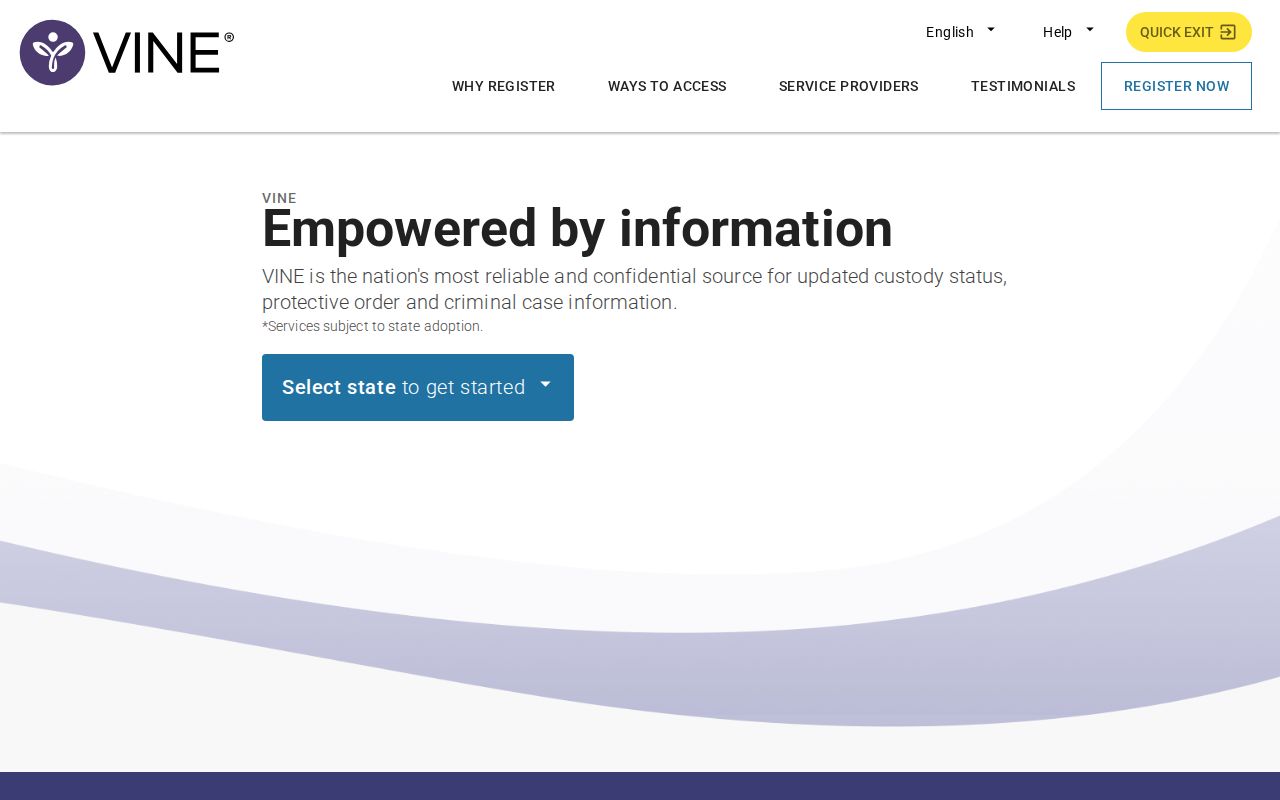
Select Wisconsin and the county-jail service, then verify uncertain results with the jail.
Where Lafayette County Arrests Are Published
Each official source owns one stage of an arrest. The sheriff holds the county booking files. VINE reports custody, WCCA shows court status, and Wisconsin DOC covers state custody or supervision. The Monroe Times and WGLR can pin down dated events. They never serve as full custody ledgers. Lafayette County has no verified page on Busted Newspaper, RecentlyBooked, or Mugshots.com. The same goes for Arrests.org and Mugshots.zone. Treat no generic directory as official. The local Cops/Courts capture displays that secondary, date-batched news layer.
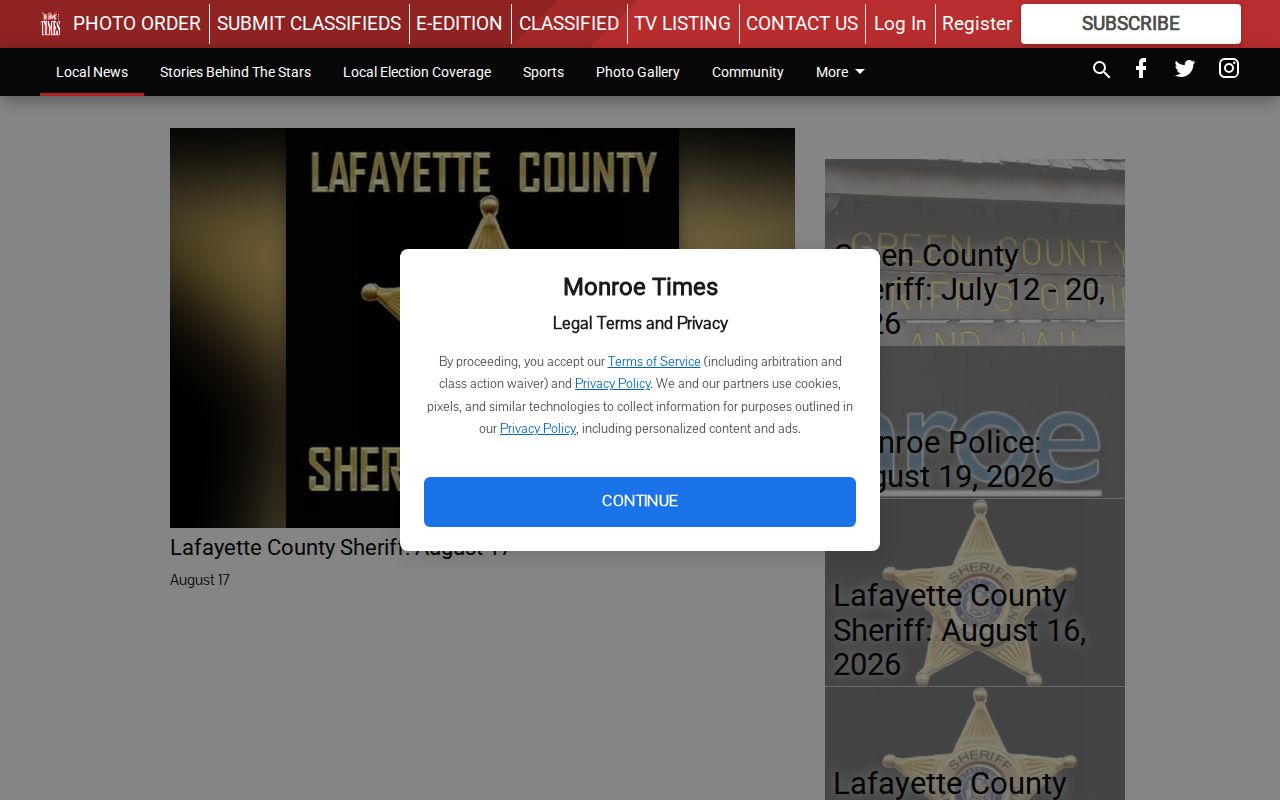
News items require custody and court follow-up because they can be delayed or incomplete.
Recent Arrests by City
City pages split the county picture. Darlington Recent Arrests separates city police reports from county jail bookings. Cuba City Recent Arrests covers the city's Lafayette and Grant County split. Shullsburg Recent Arrests pairs the city police contact with the Lafayette jail. It then adds the VINE and court path. One incident can still produce two different records.
What a Lafayette County Arrest Record Shows
A full booking record can carry a lot. Expect identity, arrest and booking times, the arresting agency, location, charge labels, warrant or hold basis, booking number, bond, custody status, release or transfer, and a photograph. Medical, classification, victim, and security material may stay closed. A court case number may show up later.
- Booking
- The jail intake process after an arrest.
- Bond
- A release condition, not a case result.
- Disposition
- The court’s recorded outcome.
- Detainer
- A request or basis for another authority to hold or receive a person.
Always match the record to its date and source, since a charge label can change after prosecutor review.
Lafayette County Mugshots and Booking Photos
Every arrest in Lafayette County starts with a photograph. Jail staff take booking photos as part of intake. The sheriff's office publishes no online mugshot gallery, though, so those images sit in agency files unless someone asks. Wisconsin DOC profile pictures, where they exist, relate to state custody or supervision rather than to a county arrest.
To request a booking photo, give the person's name and booking date. The office's records form covers photographs. It lists a $20 charge for a CD or DVD holding audio, video, or photos. Ask about digital delivery and request an estimate. Privacy rules, juvenile protections, and open cases can all limit what gets released.
How to Obtain a Lafayette County Arrest Record
Use the official sheriff request form under Wisconsin open-records law.
- Name the person, incident date, location, and arresting agency.
- Request releasable booking and release records, booking number, charges, bond, custody status, and photograph.
- State a date range and maximum fee.
- Ask for the legal basis of any withholding and for separable public portions.
- Confirm delivery format, cost, and response timing.
The sheriff's form sets report and media fees. It also asks for a written response within ten days. Wisconsin offers a state CCH route to remove arrest information. The route applies after no charge, dismissal, or acquittal. It does not automatically erase a jail photo, news story, or court page. No Lafayette-specific free aggregator opt-out exists. Skip paid-removal schemes and use official, court, publisher, and platform processes instead. The Wisconsin court forms index displays current expungement forms.

Eligibility depends on the case and the law, and filing a form never wipes every related record.
Arrest Records and Wisconsin Law
Wisconsin's open-records law runs from Statutes sections 19.31 through 19.39. Access is presumed but subject to exceptions and a balancing test. No law guarantees an unredacted roster, a photo gallery, or instant delivery. Lafayette's retention schedule splits the timelines. Arrest records last CR plus eight years. Incident records get CR plus ten, inmate files event plus eight, and surveillance 121 days. Active holds can stop destruction.
Juvenile, victim, medical, confidential, and security material needs special handling. For older files, ask whether a record was held, destroyed, microfilmed, retained, or sent to the Wisconsin Historical Society.
Warrants and the Lafayette County Most Wanted List
The Lafayette County sheriff's warrant page is built around images and points users to Wisconsin Court Access. It posts no schedule or timestamps. No photo policy or warrant count appears. To confirm a Lafayette County warrant, open the sheriff page, search WCCA for the case, and call the sheriff's office directly. The issuing county and the holding jail can differ. WGLR once reported a Lafayette warrant arrest booked into Grant County Jail. Never confront anyone based on a web image. In an emergency call law enforcement, and take personal warrant questions to an attorney or the court.
After the Arrest: Court Dates and Dispositions
Booking is only the start. An initial appearance, a bond decision, and a prosecutor review come next, and eligible cases can be diverted into Lafayette Treatment Court. Dismissal, a plea, or a trial may follow later. Search WCCA for filed cases, or contact the Clerk of Courts at the courthouse, since a person can also be released before any charge is filed.
State Prison and Federal Custody
The Wisconsin DOC locator covers people in state custody or on community supervision, not fresh county bookings. The BOP locator reaches federal inmates from 1982 onward. It offers no general public mugshot field. ICE runs its own detainee locator, and the U.S. Marshals Western District includes Lafayette County without a county-style detainee roster. The DOC search screen shows its query fields.
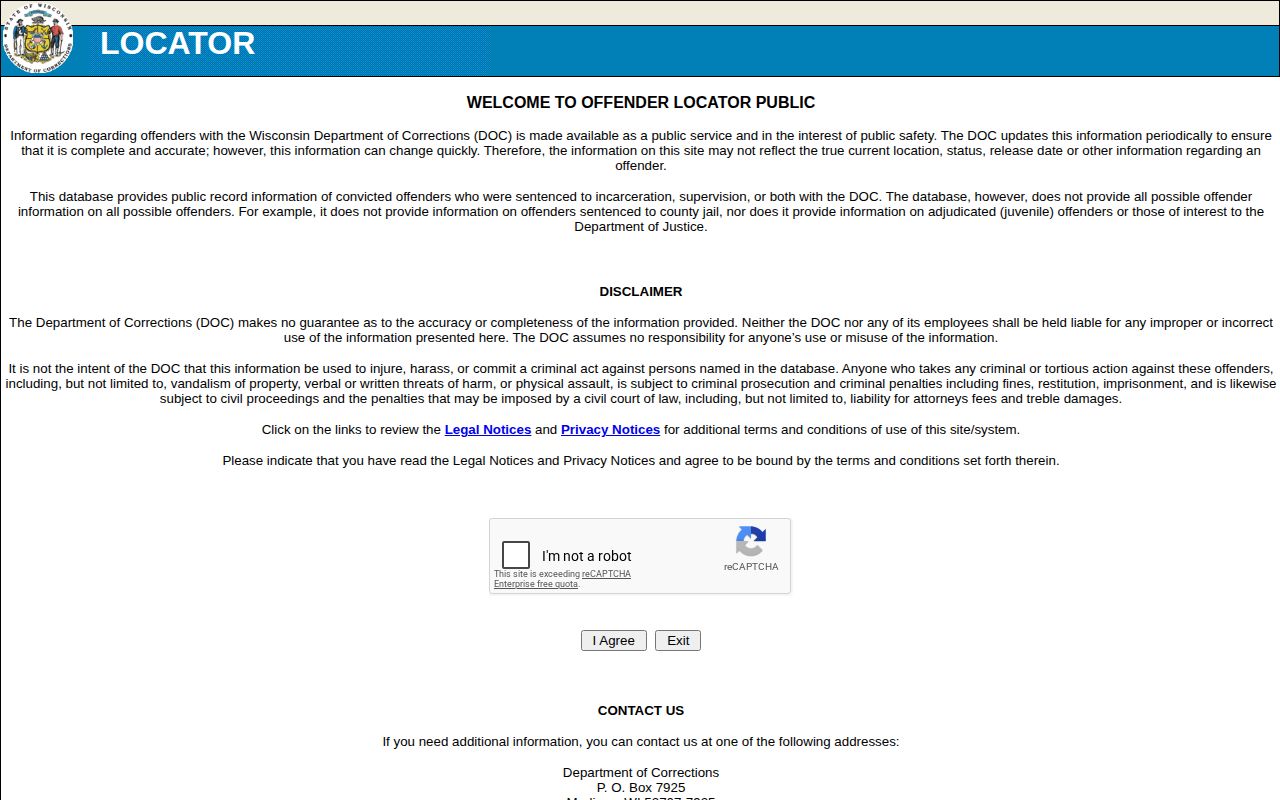
A DOC result of "not found" does not rule out a county arrest. Go back to VINE and the jail.
When Lafayette Arrest Records Appear
A Lafayette County arrest creates records at different speeds. The jail, VINE, the news, and WCCA each move on their own clock. Booking comes with real work. Staff verify identity, take fingerprints and a photograph, screen for medical and mental-health needs, inventory property, and process release conditions. That takes time. Someone arrested late at night can sit in the building hours before VINE shows the custody record. Others never become a current jail result at all. A person may be cited, released outright, or booked in a different county. Timestamps solve most of this. Ask for the arrest date and the booking date separately, since they can differ by hours. Write down when VINE was checked and which county was selected. Note release or transfer times too. A Monroe Times story can lag by weeks. WCCA may lag until a case is filed. Cuba City adds a geographic twist. The municipality straddles the county line. In the WGLR case, a Cuba City event tied to a Lafayette warrant still ended with a booking at Grant County Jail. So search where the person was physically booked, not where the warrant came from or where the home address sits. Note: A source checked too early, or in the wrong county, can return no match even when an arrest and booking occurred.
Lafayette Arrest Record Custodians
One Lafayette County arrest can scatter its paperwork across several offices. No single custodian holds it all. The arresting police department or sheriff keeps the officer's incident narrative. Lafayette County Jail controls its booking, release, and operational records. The Clerk of Courts maintains the filed case. Wisconsin DOC matters only if the person later enters state custody or supervision. Ask one office for everything and you will wait. It may not hold the other agency's file. Darlington shows how a city handles this. Its police department publishes a request path. It names its legal custodians and lists fees for paper, electronic, DVD, flash-drive, search, and postage work. The sheriff remains the right destination for a county jail booking photo. The same office holds the release record. Cuba City uses its own city form. Add a parallel request to Grant County when that jail took custody. Shullsburg publishes the police contact but no fee schedule, so confirm costs first. Narrow requests work best. Give an incident date or short range, the place, and the likely agency. Add the full name and the formats you want. Keep the police report separate from the jail booking record. If part of a record is withheld, ask the custodian to state the legal basis. Any separable public portion should still be released.
Older Lafayette County Arrest Records
A dead link does not mean the record died with it. Lafayette County keeps each record series on its own clock. The county schedule marks arrest records CR plus eight years. Incident records get ten. Jailer and inmate daily-activity logs run eight years. Inmate files use eight years tied to an event, with release named as the trigger. Surveillance audio and video are different. Those survive just 121 days unless a hold or another rule keeps them longer.
The jail inmate register carries an S code in the schedule. Quote that code as written. Clarify its meaning with the custodian instead of guessing at an expansion. Holds matter here too. A litigation, audit, or public-records hold can pause normal disposal. Juvenile records follow separate rules. Treat them as their own category, never adult booking material. Retention is one thing and disclosure is another. A record can still exist. Yet confidential, personally identifiable, victim, medical, or security content stays protected.
For an older Lafayette County booking, start with a date-bounded sheriff request. Cite the likely series. Ask whether the record stayed local or was destroyed under schedule. Was it microfilmed, placed on hold, or transferred? Wisconsin local governments must give the Wisconsin Historical Society notice before destroying certain obsolete records. A waiver can excuse this. No specific Lafayette booking-register accession is listed. Confirm any archive transfer rather than assuming one happened.
Lafayette Arrest and Custody Stages
The right search tool depends on where the person is in the process. Someone just arrested may sit only in the arresting agency's records. Transport and intake take time. After booking into Lafayette County Jail, the person may show up on VINE. The data can lag. Release changes things. The person drops off the current custody list. Booking and release records stay with the sheriff. Once a criminal case is filed, WCCA supplies the docket and eventual disposition.
| Stage | Best Lafayette source | What it cannot prove |
|---|---|---|
| Just arrested | Arresting agency and jail phone | Final booking or court outcome |
| In county custody | VINE and Lafayette County Jail | Guilt or final charges |
| Released or transferred | Jail release record and receiving agency | That the case ended |
| Case filed | WCCA and Clerk of Courts | Current jail location by itself |
| State custody or supervision | Wisconsin DOC locator | A fresh county arrest |
| Federal or ICE custody | BOP or ICE locator | Ordinary Lafayette jail history |
Movement between stages explains most apparent conflicts. A newspaper can report a booking and release correctly. A later VINE check then shows no current custody. A county release can also mean transfer into Grant County, DOC, another county, federal custody, or ICE custody. Preserve the source and its timestamp instead of forcing every record into one status.
Verify Lafayette Arrest Outcomes
A Lafayette County booking record marks an arrest. It captures custody, not the close of a case. After an initial appearance, everything can shift. A prosecutor may file different counts, decline one, or amend the paperwork written at booking. The court may dismiss, acquit, accept a plea, sentence, or send an eligible person to Lafayette County Treatment Court instead. The final outcome lives in the court record, never in a mugshot or an old blotter entry.
WCCA makes the check simple. Search by name plus Lafayette County, then confirm identity with case details. A fresh arrest may not appear right away. Municipal ordinance matters can follow a different route. The Clerk of Courts sits at the courthouse administrative address, 626 Main Street in Darlington. That is not the jail on West Catherine Street. Keeping the two straight stops a custody question from going to court staff, or a court-file question from going to jail staff. Call ahead if a case number is missing.
Wisconsin DOJ describes a fingerprint-supported removal process. It covers an eligible arrest that ended with no charge, a dismissal, an acquittal, or another qualifying cleared outcome. That process does not scrub a sheriff report, booking photo, newspaper article, search result, or court page. Each source sets its own rules. Access, correction, and retention all differ. Ask each holder directly. No paid service is needed to request a correction from an official custodian or publisher.
Note: Always pair the booking charge with the dated court disposition before describing how a Lafayette County case ended.
Lafayette County Sheriff’s Office Location and Directions
Public Record Search
Sponsored Results